


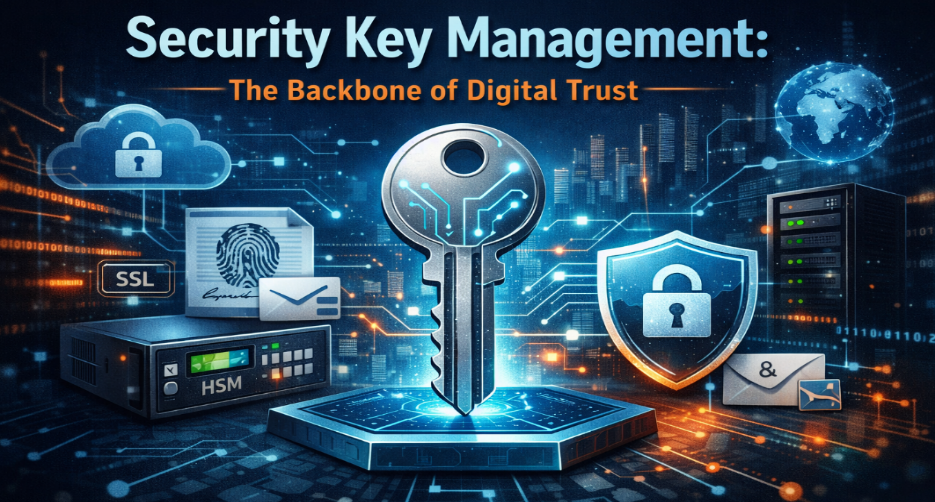
These days, almost everything relies on cryptography in one way or another, whether it is SSL/TLS, digital signing, identity systems, or encryption.
But when people talk about security, they usually focus on the algorithm or the technology itself. What often gets overlooked is something much more practical: how the keys are managed.
Because no matter how strong the encryption is, if the keys are poorly handled, the whole thing can fall apart.
What is security key management?
In simple terms, it is the way cryptographic keys are handled from start to finish.
That includes:
- how the keys are created
- where they are stored
- who is allowed to access them
- when they should be rotated
- how they are revoked or destroyed
It sounds straightforward, but this is one of the most important parts of any cryptographic system.

Why does it matter?
A lot of security problems in real environments are not caused by weak encryption. They happen because keys are not managed properly.
For example:
- private keys are stored in plaintext
- certificates expire without anyone noticing
- the same keys are kept in use for too long
- nobody has a clear view of where certificates are deployed
Once a key is exposed or mishandled, the impact can be serious.
An attacker may be able to impersonate a system, decrypt sensitive information, or get around the trust built into the environment. And when it reaches that stage, the problem is no longer minor. It becomes a full compromise.
What good key management looks like
First, keys should be generated properly using strong standards and in a secure environment. For more sensitive use cases, this is usually done inside an HSM.
Second, private keys need to be stored securely. They should never be left exposed or kept in insecure locations. Depending on the setup, this could mean using HSMs, TPMs, or a cloud KMS.
Third, access must be controlled properly. Not everyone should be able to view or use sensitive keys. Good practice includes role-based access control, separation of duties, and stronger approval controls for critical actions.
Then there is the lifecycle itself. Keys should be rotated regularly, replaced before expiry, and retired properly when they are no longer needed.
The challenge in real life
In theory, all of this sounds manageable. In reality, it often is not.
Certificates end up scattered across servers, load balancers, applications, and cloud platforms. Different teams may be using different CAs. Some environments still rely heavily on spreadsheets or manual tracking. After some time, nobody has a complete picture anymore.
That is usually when problems start showing up, such as expired certificates, unmanaged keys, duplicated certificates, or avoidable outages.
This is why centralised management and automation matter so much. At a certain scale, manual handling is just not enough.
What actually helps

In practice, a few things make the biggest difference: using HSMs for critical keys, centralising certificate and key management, reducing reliance on manual tracking, automating renewals and monitoring, limiting access to authorised personnel, and ensuring key usage is logged and auditable.
These are not complicated measures, but they are the ones that make a real difference in reducing risk.
The organisations likely to struggle in the PQC transition are not those lacking quantum expertise.
Final thoughts
At the end of the day, key management is really about control and visibility.
You can have strong encryption and a solid security design, but if the keys are not managed properly, the whole setup is at risk.
This is why key management is not just an operational concern. It is a critical part of overall security.
Follow us on LinkedIn for the latest happenings/updates.